Showing posts with label fireworks. Show all posts

Friday, May 23, 2008

FOR OUR FREEDOM


Memorial Day is much more than a three-day weekend that marks the beginning of summer. To many people, especially the nation's thousands of combat veterans, this day, which has a history stretching back all the way to the Civil War, is an important reminder of those who died in the service of their country.

Uncover the interesting history of the holiday we now call Memorial Day. Discover little-known facts about America's Wars and stop by the Veterans Forum message boards to share your views with veterans, their loved ones and fellow history buffs.

History of MEMORIAL DAY HOLIDAY

It's the beginning of Summer and time for fun in the Sun, boating, picnics and backyard cookouts. But do you know the actual meaning of our Memorial Day Observance? Thanks to www.history.com for giving us a "heads up."

Have a wonderful celebration with your family and friends, but most of all remember the reason for this holiday.

Enjoy!

Dale


Memorial Day was originally known as Decoration Day because it was a time set aside to honor the nation's Civil War dead by decorating their graves. It was first widely observed on May 30, 1868, to commemorate the sacrifices of Civil War soldiers, by proclamation of General John A. Logan of the Grand Army of the Republic, an organization of former sailors and soldiers.


On May 5, 1868, Logan declared in General Order No. 11 that:


The 30th of May, 1868, is designated for the purpose of strewing with flowers, or otherwise decorating the graves of comrades who died in defense of their country during the late rebellion, and whose bodies now lie in almost every city, village, and hamlet churchyard in the land. In this observance no form of ceremony is prescribed, but posts and comrades will in their own way arrange such fitting services and testimonials of respect as circumstances may permit.

During the first celebration of Decoration Day, General James Garfield made a speech at Arlington National Cemetery, after which 5,000 participants helped to decorate the graves of the more than 20,000 Union and Confederate soldiers buried in the cemetery.

This 1868 celebration was inspired by local observances of the day in several towns throughout America that had taken place in the three years since the Civil War. In fact, several Northern and Southern cities claim to be the birthplace of Memorial Day, including Columbus, Miss.; Macon, Ga.; Richmond, Va.; Boalsburg, Pa.; and Carbondale, Ill.

In 1966, the federal government, under the direction of President Lyndon Johnson, declared Waterloo, N.Y., the official birthplace of Memorial Day. They chose Waterloo—which had first celebrated the day on May 5, 1866—because the town had made Memorial Day an annual, community-wide event during which businesses closed and residents decorated the graves of soldiers with flowers and flags.

By the late 1800s, many communities across the country had begun to celebrate Memorial Day and, after World War I, observances also began to honor those who had died in all of America's wars. In 1971, Congress declared Memorial Day a national holiday to be celebrated the last Monday in May. (Veterans Day, a day set aside to honor all veterans, living and dead, is celebrated each year on November 11.)

Today, Memorial Day is celebrated at Arlington National Cemetery with a ceremony in which a small American flag is placed on each grave. Also, it is customary for the president or vice-president to give a speech honoring the contributions of the dead and lay a wreath at the Tomb of the Unknown Soldier. About 5,000 people attend the ceremony annually.
Several Southern states continue to set aside a special day for honoring the Confederate dead, which is usually called Confederate Memorial Day.

Thursday, December 27, 2007

"Auld Lang Syne" lyrics

"Auld Lang Syne"
by Robert Burns

Should auld acquaintance be forgot,
And never brought to mind?
Should auld acquaintance be forgot,
And auld lang syne.

CHORUS:
For auld lang syne, my dear,
For auld lang syne,
We'll tak a cup of kindness yet,
For auld lang syne!

And surely ye'll be your pint-stowp,
And surely I'll be mine,
And we'll tak a cup o kindness yet,
For auld lang syne!

We twa hae run about the braes,
And pou'd the gowans fine,
But we've wander'd monie a weary fit,
Sin auld lang syne.

We twa hae paidl'd in the burn,
Frae morning sun till dine,
But seas between us braid hae roar'd
Sin auld lang syne.

And there's a hand my trusty fiere,
And gie's a hand o thine,
And we'll tak a right guid-willie waught,
For auld lang syne.

Auld Lang Syne and other New Year's customs


by Borgna Brunner


The most commonly sung song for English-speakers on New Year's eve, "Auld Lang Syne" is an old Scottish song that was first published by the poet Robert Burns in the 1796 edition of the book, Scots Musical Museum. Burns transcribed it (and made some refinements to the lyrics) after he heard it sung by an old man from the Ayrshire area of Scotland, Burns's homeland.

It is often remarked that "Auld Lang Syne" is one of the most popular songs that nobody knows the lyrics to. "Auld Lang Syne" literally translates as "old long since" and means "times gone by." The song asks whether old friends and times will be forgotten and promises to remember people of the past with fondness, "For auld lang syne, we'll tak a cup o' kindness yet."

The lesser known verses continue this theme, lamenting how friends who once used to "run about the braes,/ And pou'd the gowans fine" (run about the hills and pulled up the daisies) and "paidl'd in the burn/Frae morning sun till dine" (paddled in the stream from morning to dusk) have become divided by time and distance—"seas between us braid hae roar'd" (broad seas have roared between us). Yet there is always time for old friends to get together—if not in person then in memory—and "tak a right guid-willie waught" (a good-will drink).

But it was bandleader Guy Lombardo, and not Robert Burns, who popularized the song and turned it into a New Year's tradition. Lombardo first heard "Auld Lang Syne" in his hometown of London, Ontario, where it was sung by Scottish immigrants. When he and his brothers formed the famous dance band, Guy Lombardo and His Royal Canadians, the song became one of their standards. Lombardo played the song at midnight at a New Year's eve party at the Roosevelt Hotel in New York City in 1929, and a tradition was born. After that, Lombardo's version of the song was played every New Year's eve from the 1930s until 1976 at the Waldorf Astoria. In the first years it was broadcast on radio, and then on television. The song became such a New Year's tradition that "Life magazine wrote that if Lombardo failed to play 'Auld Lang Syne,' the American public would not believe that the new year had really arrived."

Hogmanay (Scotland)

The birthplace of "Auld Lang Syne" is also the home of Hogmanay (hog-mah-NAY), the rousing Scottish New Year's celebration (the origins of the name are obscure). One of the traditions is "first-footing." Shortly after midnight on New Year's eve, neighbors pay visits to each other and impart New Year's wishes. Traditionally, First foots used to bring along a gift of coal for the fire, or shortbread. It is considered especially lucky if a tall, dark, and handsome man is the first to enter your house after the new year is rung in. The Edinburgh Hogmanay celebration is the largest in the country, and consists of an all-night street party (visit their Hagmanay website here).

Oshogatsu (Japan)

The new year is the most important holiday in Japan, and is a symbol of renewal. In December, various Bonenkai or "forget-the-year parties" are held to bid farewell to the problems and concerns of the past year and prepare for a new beginning. Misunderstandings and grudges are forgiven and houses are scrubbed. At midnight on Dec. 31, Buddhist temples strike their gongs 108 times, in a effort to expel 108 types of human weakness. New Year's day itself is a day of joy and no work is to be done. Children receive otoshidamas, small gifts with money inside. Sending New Year's cards is a popular tradition—if postmarked by a certain date, the Japanese post office guarantees delivery of all New Year's cards on Jan. 1.

Spain

The Spanish ritual on New Year's eve is to eat twelve grapes at midnight. The tradition is meant to secure twelve happy months in the coming year.

The Netherlands

The Dutch burn bonfires of Christmas trees on the street and launch fireworks. The fires are meant to purge the old and welcome the new.

Greece

In Greece, New Year's day is also the Festival of St. Basil, one of the founders of the Greek Orthodox Church. One of the traditional foods served is Vassilopitta, or St Basil's cake. A silver or gold coin is baked inside the cake. Whoever finds the coin in their piece of cake will be especially lucky during the coming year.

United States

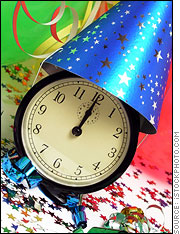
Probably the most famous tradition in the United States is the dropping of the New Year ball in Times Square, New York City, at 11:59 P.M. Thousands gather to watch the ball make its one-minute descent, arriving exactly at midnight. The tradition first began in 1907. The original ball was made of iron and wood; the current ball is made of Waterford Crystal, weighs 1,070 pounds, and is six feet in diameter.

A traditional southern New Year's dish is Hoppin' John—black eyed peas and ham hocks. An old saying goes, "Eat peas on New Year's day to have plenty of everything the rest of the year."
Another American tradition is the Rose Bowl in Pasadena, California. The Tournament of Roses parade that precedes the football game on New Year's day is made up of elaborate and inventive floats. The first parade was held in 1886.

Widely Observed New Year Symbols and Traditions

Resolutions: It is believed that the Babylonians were the first to make New Year's resolutions, and people all over the world have been breaking them ever since. The early Christians believed the first day of the new year should be spent reflecting on past mistakes and resolving to improve oneself in the new year.

Fireworks: Noisemaking and fireworks on New Year's eve is believed to have originated in ancient times, when noise and fire were thought to dispel evil spirits and bring good luck. The Chinese are credited with inventing fireworks and use them to spectacular effect in their New Year's celebrations.

For more New Year's features see the History of New Year and Saying “Happy New Year!” Around the World.

Thursday, June 28, 2007

TWO BLONDS & CO. Patriotic Jewelry


14K White Gold American Flag Pendant;
(chain sold separately)

Material: 14K White Gold - 14.5x14mm
Weight (DWT): 0.88

Retail: $85.00
Our Price: $60.00

U.S. Independence Day a Civic and Social Event


Americans celebrate July 4, 1776, adoption of Declaration of Independence

By Michael Jay Friedman
Washington File Staff Writer


Washington -- The United States celebrates its Independence Day on July 4, a day of patriotic celebration and family events throughout the country.

In the words of Founding Father John Adams, the holiday would be “the great anniversary festival. It ought to be commemorated as the day of deliverance, … . It ought to be solemnized with pomp and parade, with shows, games, sports, guns, bells, bonfires, and illuminations, from one end of this continent to the other, from this time forward forever more.”

The holiday is a major civic occasion, with roots deep in the Anglo-American tradition of political freedom.

A SUMMER HOLIDAY

Community fireworks displays are common. In New York City, Macy's department store for 30 years has sponsored a July 4 fireworks display. In 2005, the 30-minute show featured 35,000 shells launched from seven barges afloat in the East River and in New York Harbor. The Associated Press estimated that more than 3 million watched in person. The event also has been televised nationally in recent years.
The Fourth" is a family celebration. Picnics and barbeques are common. July is summer in the United States, and millions of Americans escape the heat at beaches and other vacation spots. Independence Day is not among the legal holidays fixed on a Monday or Friday, but many employees use vacation time to create an extended weekend, as in 2006, when the holiday occurred on a Tuesday.
Construction of important public works sometimes begins on July 4. The Erie Canal, Washington Monument and Baltimore and Ohio Railroad (the nation's first) all broke ground on Independence Day. The date reflects a desire symbolically to stamp these projects as true civic improvements.

A CIVIC OCCASION

The Fourth of July is a time when elected officials and other public figures often give speeches extolling American traditions and values.
Independence Day has provided some of this nation's most stirring words of freedom. In 1788, Founding Father James Wilson addressed a Philadelphia gathering that was possibly the largest July 4 celebration in the young nation's history. He exhorted his fellow citizens to ratify the proposed Constitution. "What is the object exhibited to our contemplation?" he asked. "A WHOLE PEOPLE exercising its first and greatest power -- performing an act of SOVEREIGNTY, ORIGINAL and UNLIMITED….”

On July 4, 1852, the black journalist and abolitionist Frederick Douglass decried the evils of slavery, still prevalent in the American South at that time, but identified forces "drawing encouragement from the Declaration of Independence, the great principles it contains, and the genius of American Institutions in operation" that "must inevitably work The downfall of slavery."

Ninety years later, near the darkest moments of World War II, President Franklin D. Roosevelt reminded the nation that July 4 symbolized "the democratic freedom which our citizens claim as their precious birthright:" For the "weary, hungry, unequipped Army of the American Revolution," he continued:
"the Fourth of July was a tonic of hope and inspiration. So is it now…. The tough, grim men who fight for freedom in this dark hour take heart in its message -- the assurance of the right to liberty under God -- for all peoples and races and groups and nations, everywhere in the world."

On July 4, 2001, President George W. Bush spoke outside Independence Hall, Philadelphia, birthplace of the Declaration of Independence. That document, he said, continues to represent "the standard to which we hold others, and the standard by which we measure ourselves. Our greatest achievements have come when we have lived up to these ideals. Our greatest tragedies have come when we have failed to uphold them."

Across the nation, civic leaders of even the most humble station echo these words, and their audiences give thanks for the freedom and liberties that the founding generation won for all Americans.


(The Washington File is a product of the Bureau of International Information Programs, U.S. Department of State. Web site: http://usinfo.state.gov/)


A display of fireworks illuminates the sky near the Statue of Liberty as seen from Jersey City, NJ on July 4, 2004.

Journey Diamond Jewelry from Two Blonds & Co.